You have no items in your cart. Want to get some nice things?
Go shopping
Where Literature Happens · Madrid
The End of Rented Reach
What publishers own when the click disappears
For years, publishers accepted a familiar bargain. Search and social platforms distributed their work; in return, publishers got traffic. The bargain was uneasy, but it was legible.
AI is making it harder to see what publishers get back.
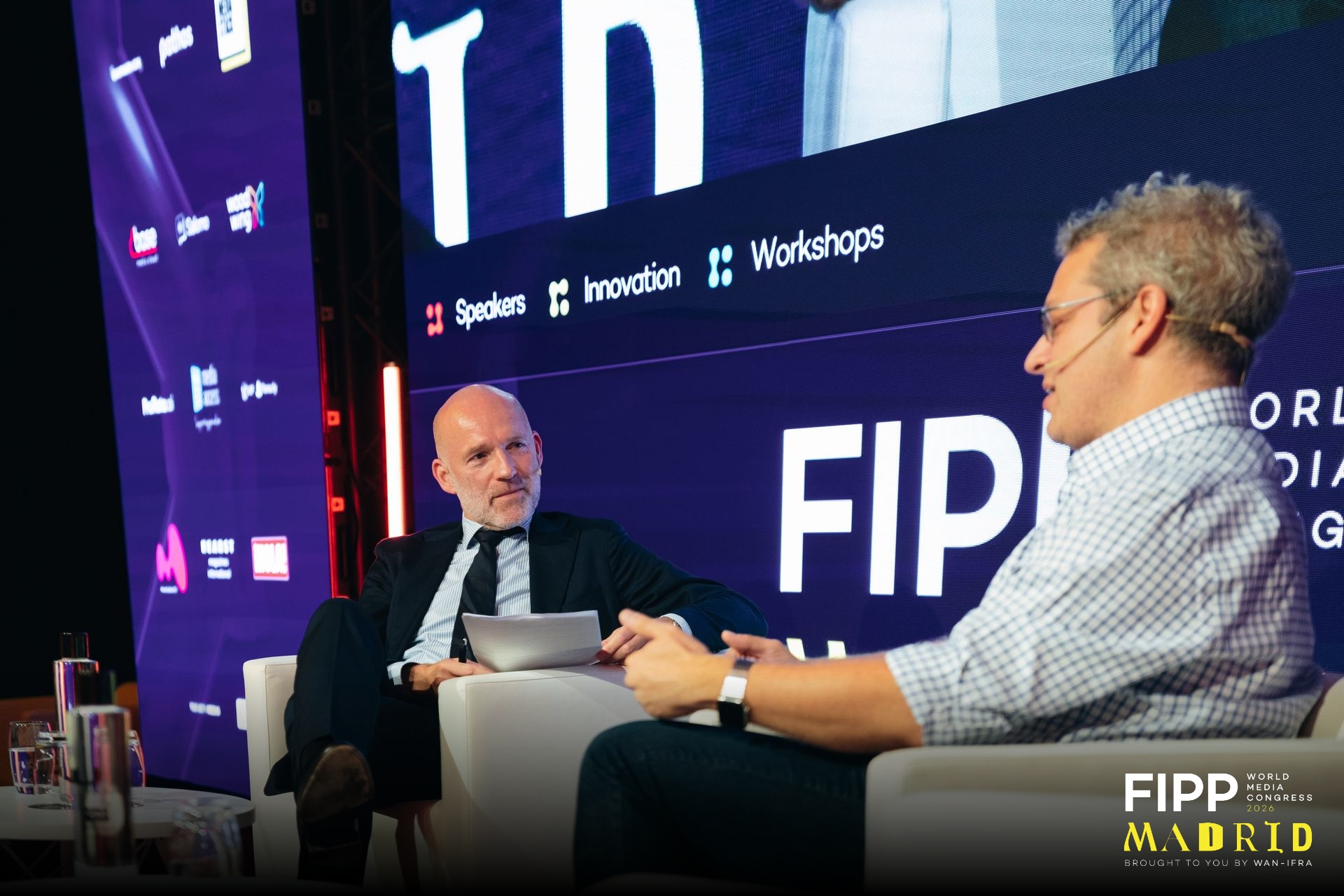
At the FIPP World Media Congress in Madrid, Stig Ørskov, chief executive of WAN-IFRA, gave the old arrangement a useful name: “rented reach”.
Publishers had become accustomed to audiences arriving through systems they did not control. Search sent the reader. Social sent the reader. The publisher supplied the work; somebody else supplied the route to it.
Now that route is becoming less dependable. Search engines, social platforms and AI systems can increasingly answer a question without requiring the reader to visit the publisher at all.
For publishers, that changes the arithmetic.
Ørskov was not arguing for retreat. His point was that access to somebody else’s audience should never be confused with having one of your own.
He talked about newsletters, direct channels, partnerships, trusted editors and individuals, live events and the slower work of building a community around something distinct. He pointed to Denmark’s Zetland as an example of a publisher built around a recognisable relationship with readers rather than indiscriminate scale.
That distinction between reach and relationship has become easy to blur.
Publishing spent years learning to count impressions, referrals and page views even when the relationship underneath those numbers was thin. A reader delivered by an algorithm may disappear as quickly as they arrived. Someone who knows why they come to a publication, recognises its editorial judgement, opens its newsletter, attends an event or simply returns because the work means something to them is harder to acquire.
They are also harder to replace.
AI did not create this weakness. It has exposed it.
A week earlier, at Frankfurt Book Fair, the same pressure was visible from another direction. Frankfurt was full of rights, translation, discovery and distribution: all the systems that allow a book to move from one language, publisher, market or territory into another.
Madrid brought the argument closer to the reader.
Magazine and news publishers were asking what happens when attention still exists, but the route back to the publisher weakens. What does a publisher actually control when discovery, distribution and increasingly the first encounter with an article are happening somewhere else?
Rights become harder to keep in the background under those conditions.
For a long time, rights could feel like something that followed the editorial work. Contracts were signed, permissions recorded, licences negotiated, royalties distributed. The expansion of AI has made that administrative layer much harder to ignore.
Amy Ellis of Publishers’ Licensing Services described an industry that is not beginning from zero. PLS already sits within long-established collective licensing arrangements for copying and reuse. It represents publishers, while the Copyright Licensing Agency issues licences and collects fees, with PLS distributing the publisher share.
Those systems are now being extended into new territory. Publishers can opt into a separate generative-AI repertoire covering uses including training, fine-tuning and retrieval-augmented generation. Around 350 publishers have joined that newer repertoire.
But joining a repertoire is not the same thing as being paid.
A rights-holder still has to know what it is entitled to license. A buyer has to exist. The permitted use has to be defined. There has to be some way of knowing what has been used and how payment should be attributed.
For the largest publishing groups, there are lawyers, rights teams and technology staff to deal with those questions.
For a literary magazine, a local publisher or a specialist title, the work may be highly distinctive while the infrastructure around it is much thinner.
That is where AI licensing becomes more interesting than another argument about whether publishing can be made faster.
At FIPP there was no shortage of software promising efficiencies. Some of it will be useful.
But efficiency is not the same thing as leverage.
If everybody can summarise, reformat, optimise and distribute content more cheaply, then the scarce things begin to sit elsewhere: editorial judgement, trust, direct relationships with readers, distinctive work and clarity about the rights attached to it.
Aisling Hilsdon of the Professional Publishers Association approached the same problem from the position of the independent publisher. The PPA represents more than 250 UK media companies across consumer, B2B, specialist and independent publishing. It can convene publishers, advocate on their behalf and help them understand the options in front of them. It is not itself the licensing agent.
That distinction is important because collective licensing can sound more complete than it currently is.
The component parts exist. Rights organisations exist. Trade associations exist. New AI licensing arrangements are being developed. Publishers are beginning to opt into them.
What smaller publishers do not necessarily have is scale.
Former Australian communications minister Paul Fletcher has seen an earlier version of the same imbalance. Australia’s News Media Bargaining Code forced a much more explicit negotiation over the value publishers were creating for major technology platforms.
But regulation did not make every publisher equal.
The largest media companies were still better placed to negotiate, with the legal teams, audiences and commercial weight to make themselves difficult to ignore.
AI does not remove that asymmetry. In some ways, it sharpens it.
The question is no longer only whether a platform links to an article. A publisher may now be trying to understand whether its material has been retrieved, summarised, quoted, used to answer a question or included in a system whose output appears somewhere else entirely.
For an independent publisher, there is no reason to pretend that is a simple thing to track.
As publisher of Litro, I could not hear that discussion only as an industry abstraction.
Litro has published original writing for more than twenty years. Behind the current publication is a long record of stories, essays, interviews and visual work.
That record does not confer some blanket ownership over everything Litro has ever published. Rights differ from work to work and depend on the agreement with the writer or contributor. Publication, copyright ownership and permission for later reuse are different things.
The arrival of new forms of reuse simply makes those distinctions harder to ignore.
What rights were granted? For what purpose? Can the original source still be identified when material moves elsewhere? Does attribution survive? What happens when a piece written for one publishing context is retrieved or summarised inside another?
These questions are not unique to Litro. They sit underneath a much broader problem now confronting publishing.
Earlier this month in Magaluf, I was reporting on a literary festival being used to complicate the identity of a place still carrying the reputation of a mass-tourism resort. The old and new Magaluf occupied the same streets.
In Frankfurt, the focus shifted from place to movement: how books travel through publishers, translators, agents, rights departments and markets.
Madrid brought the argument back to ownership of another kind: the relationship between a publication and the people who read it.
Who owns the audience?
Who controls discovery?
And when a piece of work moves beyond the page on which it was first published, what travels with it?
Ricky Sutton of Future Media approached the problem from the question of cooperation. Publishers, he argued, have historically tended to see one another first as competitors, even when some of the infrastructure problems they face are shared.
His suggestion of something like a universal API was not a description of an existing publishing system. It was a way of asking whether publishers could agree on common methods of describing and granting access to content without surrendering their editorial independence.
The technical answer is less interesting, at least for now, than the political one.
What would publishers be prepared to do together that they cannot do effectively alone?
For large publishers, direct negotiation may remain possible. For smaller ones, some form of aggregation looks increasingly difficult to avoid. That could mean collective licensing, common standards, trusted intermediaries or something that does not yet have a settled institutional shape.
The difficulty is that the interests of publishers are not identical.
A national newspaper, a trade magazine, an academic publisher and a small literary journal do not own the same kinds of work, reach the same readers or negotiate from the same position.
Any collective system strong enough to give smaller publishers leverage would also have to be flexible enough not to flatten those differences.
This may be where the argument becomes less about technology than organisation.
Publishers already have trade bodies. They have licensing agencies. They have rights departments, standards organisations and collective-management systems. What is not yet obvious is whether those existing structures are enough for a market in which the use of published work may become harder to see at exactly the moment its value is being contested.
Ørskov was cautious about treating AI licensing as easy money. Distinctive, high-quality content may create licensing opportunities, but a small publisher should not assume that a major technology company is about to arrive with a contract.
The audience business still has to work.
An archive is not automatically a market. A direct audience is not automatically a paying one. A collective mechanism matters only where there is a real use, a real buyer and rights that can actually be licensed.
That leaves publishers with a less dramatic task than much of the AI conversation suggests.
They need to know which relationships are genuinely theirs.
Search and social never belonged to publishers, however accustomed we became to their traffic.
The reader relationship can.
So can the editorial judgement that gives a publication its identity.
And where rights are concerned, the first requirement is not to claim more than a publisher owns, but to know exactly what it does.
Madrid did not settle what form of collective power smaller publishers will need.
It did make the absence of it harder to ignore.
More from Litro
What Is a Literary Festival Doing in Magaluf?
A resort known for mass tourism tries another identity.
Who Owns the Future of Publishing?
From Frankfurt Book Fair: rights, discovery and who controls the route between books and readers.