You have no items in your cart. Want to get some nice things?
Go shopping
My mother called the next morning while I was getting ready for work to ask about the tick bite. I had nothing interesting to tell her other than it had reduced to a tiny red dot overnight. She sounded disappointed.
“So nothing’s come of it then?” she said.
“I guess not,” I replied.
“You don’t need to see the doctor?”
“I’ve nothing much to show them if I went.”
There was a pause. “Right. Well, what about your midwife? Don’t you think you should text her? I’ve just been researching it, and you need to be careful of Lyme disease.”
“Isn’t Lyme disease an American thing?” I asked, kissing my husband’s sticky mouth on the way out the door, tucking my phone under my chin.
“No,” my mother said after a pause, probably tilting an ear away from the sound of my front door slamming as I left the flat. “Lyme disease is a tick thing.”
She sounded frustrated, as she usually did when I didn’t take things as seriously as she did. I sighed away from the mouthpiece, partly from the disturbance of my already disturbed morning (even though the baby had been peaceful in my belly that night, my mind had pulsed with thoughts and thudding nags, like the heartbeat I’d heard a few weeks ago at my twenty week growth scan, strong and fast, and disconcerting if I’m honest, the little kicking muscle nestled deep inside me, deep inside my baby) and partly from the rain.
“Just tell me again then,” my mother said. “What exactly happened?”
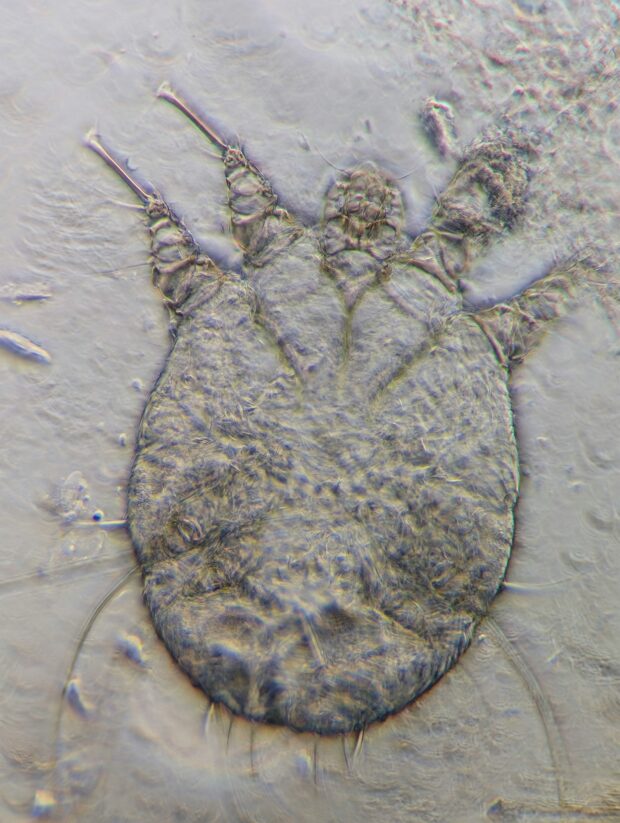
I pushed my umbrella up towards the falling sky and told her I’d been reading in bed, fingers scouring my body, looking for things to pick. It’s a habit of mine, one my mother has always hated, yet one she has herself also. I’ve seen her countless times, her sharp nails scraping the surface of her forehead, her scalp, her lips. The night before, my finger had come upon a tough, raised piece of skin on the outside of my right thigh. Without looking, my other hand holding a Hypnobirthing book that bored me, I circled it, approached the spot tentatively, and then squeezed and scraped until it came away. Only, on inspection, the object of my compulsion hadn’t been skin at all but an engorged silver-backed tick. I held it between my thumb and finger, having managed to pull the whole thing clear out of my skin, its legs mechanically reaching, its body plump and greyish from all my blood. I threw my legs over the side of the bed, inspected the site of the bite, which was a tiny, angry red speck on my skin, then flushed the tick down the toilet.
I was certain my mother had already listened to my voice notes several times, relaying all this. They’d been forensic in detail, although I’d tried to stay as calm. I listened back once they were sent, to them to make sure I wouldn’t scare her or bring about her own night time insomnia. But she hadn’t heard them until the morning and had called me immediately to hear what exactly happened.
“And that’s it, really,” I finished, approaching the station.
“Right,” my mother replied. “Well, if that’s it.”
“It is. I’m just getting on the train.”
“Right. Have a nice day.”
“Thanks.”
“Please text your midwife.”
My mother had retired six months before from her role as deputy head at a middling secondary school. She’d been restless and depressed since leaving teaching. When I called to cry about my constant vomiting and exhaustion in the first few months of my pregnancy, she’d cry back and tell me how she couldn’t sleep either, how she felt she was going mad. Often, I’d picture her stood in her dressing gown alone in her house, the cold light of the upstairs landing shadowing her face, watching the harried and sodden schoolchildren traipsing past twice a day, arguing whether it really was a ghost they could see in the window of the house across street in the window of the house with the nice curtains and overgrown rose bushes.
But recently, she’d been asked if she couldn’t possibly cover some classes, biology and some humanities classes, too, for several teachers they the school had off sick with stress. Her sleep struggles were buoyed once again with work-related exhaustion, and her tearful phone calls had stopped completely. With her new found energy, she spent her time worrying endlessly about me and my life and my pregnancy.
Before falling into teaching, as many people used to, back when it was easier to fall into careers than it is these days, she had wanted to study tropical medicine or microbiology. It was an unfulfilled passion that expressed itself in the precise inspection and clipping of our toenails, forensic application of headlice medication then endless hours combing my infested hair, an over-reaction to any sign of mucus or fever, and a catastrophizing of common ailments and illnesses.
I knew my nonchalance about the tick bite was a childish reaction to the edge in her voice, the worry that seemed so constant and impending that I couldn’t sense genuine caring in her anymore. Instead, her concern felt like a predictable script from a midday medical-based television show. But despite all this, once on the train, I texted my midwife. By the time we were at the next station, she’d responded with a curt reply, a link to an NHS information page, and the sense that I definitely shouldn’t have bothered her.
I thought about my second breakfast hiding in my bag; Ritz crackers, peanut butter, and jam. Every morning, I tried to wait until I was at work before eating it, and every morning, I’d end up covered in crumbs by the time I got to my desk.
I worked in an office just north of the city centre as an HR manager for a company that designed nice kitchens. After a few years of jumping from one temp agency to the next after I left school, I was offered a permanent contract at the family-run business that had, under the helm of the founder’s daughter-in-law, in recent years expanded beyond kitchens, to bathrooms and garden design too. I’d become busier and more senior, getting on well with the daughter-in-law because I was always very happy where I was and never strived for anything more.
“I just know I can count on you,” she told me once in an appraisal. “You’re like furniture in this place.” I’d been there fifteen years last Spring, so I told her I’d probably been around even longer.
The fact I’d never followed my mother into a career in education or ever really seemed bothered in getting one of my own was something my mother liked to lament. When I tried reminding her of all the nights she’d come home late, relaying the day’s events in a furious monologue over dinner on our laps in front of the television, scattering confidential details of children and families as she went, then pressing a finger to my lips and hissing that I should never, ever repeat any of this to anyone, finishing with the usual line that I should never work with children or animals, she’d simply smile and shake her head. “Best years of my life,” she’d say.
I took my phone out of my bag. “Hi. I just thought I’d let you know; the midwife replied.”
“You decided to message her then?” my mother said flatly.
“Yes. You said I should.”
“I did. But when have you ever done what I’ve told you?” my mother said, then made a slight sound that could’ve been a laugh or a cry of relief.
“Well. She said not to worry. She sent me a link. I’ll forward it to you.”
“You told her what happened exactly?”
“Yes.”
“Well, she’s the expert, I suppose. Sounds busy where you are.”
“Rush hour,” I said.
“I don’t know how you keep going. You must be even bigger than when I last saw you, by now?” my mother said.
“Two more months, then I’m on maternity. If I make it.”
“If this tick doesn’t speed it along!”
“That can’t happen, can it?” I asked.
“With all the drama you’ve made of it, I wouldn’t be surprised,” my mother laughed.
We stood on the pavement outside the surgery and tried to decide what to do. I told my husband not to call my mother; it’d only worry her. Barely five minutes into our Uber ride to the hospital, I was weeping, telling her I’d had some cramps and was called in for an emergency midwife appointment, then been told I was in early labour and needed to go to the hospital immediately. I was thirty-four weeks.
I didn’t wait to hear her reply, I was crying too hard, and scared and in pain. But I could tell from the sounds my husband made, finishing the conversation, that my mother was on her way.
The birth was fast, and when I think of it now, I can only describe it as being pushed through a long tunnel in a crowded train carriage, blurry with light, cramped with strangers and their voices. I felt so thankful to emerge on the other side, but I was left wondering where I’d just been or where I’d come from.
My mother arrived sometime in the middle of my journey with groaning sandwiches in paper bags marked with a stamp from the expensive deli around the corner and a small but tightly packed suitcase. Her brow was creased with concern, even if her cheeks were smoothed with her smile. Her arrival, and my baby’s, are all I can remember.
My baby was born with his eyes open. He was crying. He smelt of iron and what I suppose was the inside of me. He had a suction cup applied to his head to help him, which left a small circle of blood on the crown of his head. It grew black during his first few days, then fell off on its own.
“Be careful not to touch it,” my mother told me. “I know what you’re like.”
“He has olive colouring,” I said, noticing the contrast between his golden skin and the white cardigan I’d bought the week before, thinking there’d be plenty of time to wash the plastic smell of the shop from its fine threads.
“Well, he must get that from his dad,” my mother said.
“I guess so,” I said. “Do you think we should ask someone, though?”
“Maybe. Maybe we should get the midwife to check him.”
“Just quickly?”
“Yes.” My mother reached out and stroked the edge of his ear, then peered at the back of his neck. “But he’s perfect, isn’t he?”
“Yes,” I said.
“After all that,” my mother said.
Story Sunday
More new fiction from Litro
Read the latest Story Sunday selections.