You have no items in your cart. Want to get some nice things?
Go shopping
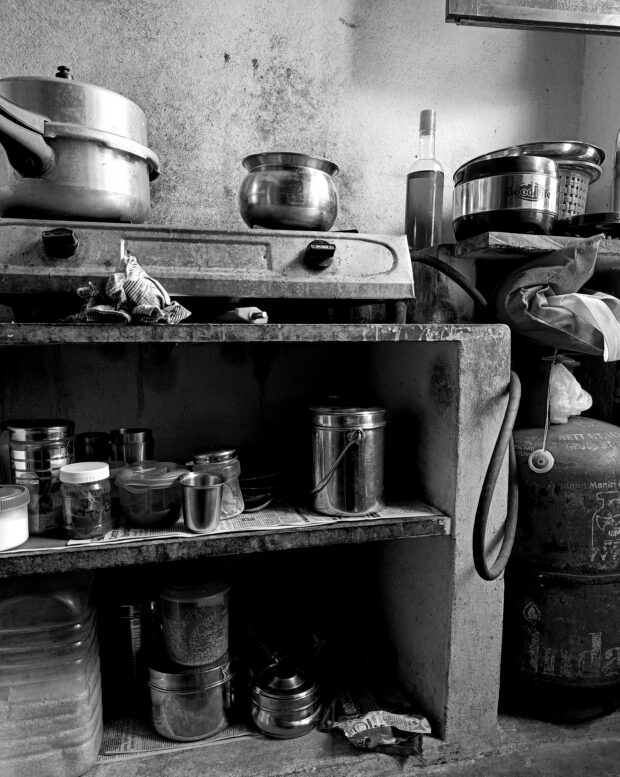
Dadi Ma slowly rinses the carrots in the colander.
It is the first foggy morning of my winter break of 2010. Mist fills the courtyard and sticks to the walls. It’s grey all around. The honey-drop sun has been absent for days.
You place the coil heater near the refrigerator. The refrigerator stands crooked, like an exhausted animal propped against the wall. The hinge had given way months ago after you heaved it down in one furious shove. The switchboard’s grimy faceplate had wrenched open that afternoon, and blue and yellow wires now peek from the cavity. The fridge’s tilt leaves just enough space to press the heater against the wall. It is easier that way to boil milk, make tea, and roast sweet potatoes in the room without braving the kitchen under the frigid winter sky.
Father warns you to be careful. Only use the heater when the voltage is steady, he says.
I sit down eagerly beside Dadi Ma to grate the carrots.
“Bibi, wash your hands first.” She slaps mine away, then pulls her shawl tighter around herself.
I run into the courtyard, pour water over my hands, and hurry back inside.
A deep steel dish sits on the mat. Dadi Ma is grating the carrots into it.
“Dadi Ma, how did you learn to make gajar halwa?” I ask, handing over the carrots one by one.
“When Shazu was born,” she says, “Baaji made it for the whole of Attarsuiya. Big celebration. I just stood there and watched. That’s how I learnt.”
“Can I also make it?”
“Yes, yes! It’s very simple, Bibi. Nothing much in it. But go read your lesson now. Otherwise, your mother will say I’m making you do all the work.”
“I’ll start tomorrow. Abba has to bring the holiday homework notebooks. He said he’ll get them in wholesale tomorrow.”
We keep grating till early afternoon, turning five kilos of carrots into fine, bright-orange shreds.
“Dadi Ma, who made gajar halwa first?”
“I don’t know exactly,” she says. “But I’ve heard they used to make it in the time of the Mughals.”
“Did they eat it every day?” I pull a few carrot strands from the steel teeth.
“Not every day, Bibi. Only in winter. When carrots came. And on big occasions.”
Carrots don’t belong to July, Ammi. In the sun, they come out wrong – gnarled, bitter.
Carrots are meant to begin in darkness. They are pushed downward first, beneath the soil, before they can surface bright. Isn’t memory like that, Ammi – what we bury before we remember?
That summer, Ammi, the sky was a sharp, cloudless blue.
I rested my head on my arms and gazed into the street. The end of summer vacation was looming just days away. At home, the hours stretched with little to fill them. Yasser, Faris, and I didn’t have much else to do. Father would sometimes join us for ludo. Or the three of us gathered for a game of carrom, though one striker was missing, and we had run out of boric powder.
The power had been out all afternoon. You sat on a polypropylene chair with your feet propped on the dining table, tossing fistfuls of raw rice into your mouth absentmindedly. Why are you always munching on rice? Sweat welled at the bump along your left hairline and trickled down. The bump was not always there. It came later. It came after you loved.
The summer entered our room through the middle window – the only one that mattered. One of the others was riddled with termites and dried frass; the other opened to a tangle of overhead wires. A six-foot wooden staff leaned permanently against the wall, used to hook katia onto live wires during outages and voltage swings. I know that a fused tubelight choke smells like a fragrant flower set on fire. Quick! It’s over 250! Slippers! The three of us would scurry to a corner, clearing the way for you or Father.
Outside, in Jaleel’s timber yard, the tall fig tree cast shade over carts stacked with wood. Woodcutters and cart-pullers sat on a wooden cot with their lungis hitched up. Deep inside the yard, in a crumbling house, lived Jhingur’s family. Jhingur, nicknamed after the insect for his grasshopper-thin frame, ran a paan stall at the entrance.
A short walk away was the biscuit bakery where men wrapped freshly baked biscuits in light brown paper. Further down, a basement factory produced bright blue plastic drums. Street dogs lay curled in the narrow drains.
My gaze returned to the figs. You told me once that if I ate them every day, the larvae inside would rid me of my spectacles. I imagined biting into the fruit, but –
“Get away from the window! The cart-pullers will screw a tawaif like you for ten bucks!” Your voice split the July afternoon.
Startled, I darted across the room, eight years old, scampering like a rabbit to its burrow. I climbed onto our rickety bed. The mattress was thrifted – slept on by another family before us. New things were always one owner away. The jute poked through in places, needling my skin. New things were always one wound closer.
I didn’t know what tawaif meant. I flipped through the Hindi-to-English dictionary.
Tawaif.
Tawaif.
Tawaif.
I lay back. The hot air dragged against my limbs. Sadness is a blue sky; it’s everywhere, Ammi.
Tawaif wasn’t there.
I wasn’t there.
How do we become what we don’t understand?
But where else could the frustrations of motherhood go if not toward the daughter you birthed at seventeen?
Dadi Ma sets a big steel pot of milk to boil on the heater.
“What does my name mean, Dadi Ma?” I ask, splitting open green cardamom pods.
She’s bent over the fridge, rummaging. “Bibi Khadija was Huzoor Sahib’s first wife,” she says, straightening up with a bowl of khoya. “She was the first woman to accept the faith.”
“But what does it mean?” I persist. “Ma’am asked me at school, and I didn’t know what to say.”
The milk begins to bubble.
“Bibi, you talk too much,” she mutters. “Girls from good families speak less. Otherwise, people say they’ve no manners.”
The milk thickens slowly, shrinking to half. A golden crust forms at the edges where it kisses the pot.
Father named me after the Prophet’s first wife.
My name is an exhale: a sigh and a release. It is very low maintenance, asking nothing of the lips, requiring no touch.
A premature birth of a girl child.
This is what my name means.
Some plants bolt under stress, Ammi. They rush past root and leaf towards seed. Conditions are bad – better reproduce before it is too late. And so life begins in a hostile condition.
It was a summer noon. I was nine, running barefoot across the stone floor while sparrows flocked to the courtyard, warm-brown and soft-grey, thirsty for water.
The western wall was lined with pink morning glories – our only colourful plants, aside from the wildflowers sprouting from cracks in the walls and floor. Dadi Ma had planted them in heavy limestone planters long before you arrived at Hasan Manzil.
One morning, I tilted a steel mug over the soil, careful not to splash the little petals.
“Bibi, what are you doing?” Dadi Ma called.
“Watering it, Dadi Ma. See how pretty it’s looking today?”
She chuckled. “That one? That’s behaya, Bibi. You don’t need to do anything. It grows without asking.”
I paused, still holding the mug. “But don’t all plants need water?”
“Some do. Some bloom even when they shouldn’t. This one grows in cracks, drains, broken walls. Shameless little thing. You can forget about it and it’ll still be there tomorrow.”
I looked at the pink flowers again.
Against walls green with algae, a steel drum rested on a stone slab propped up by chipped bricks. Tiny mosquito larvae wriggled there year-round. The drinking-water line sometimes mixed with the sewer line, turning the water murky yellow and foul. The drum held clean water for this purpose. You often washed utensils there, under the evening sky, rather than in the cramped steel-roofed kitchen.
Each morning, I poured water from that drum into a ceramic saucer for the sparrows and left it in the cool shadow of the morning glory.
You sat on the bed, fanning yourself in the still heat. The courtyard lay just beyond, well within your sight.
“Hey, keep it down, or you’ll scare them off,” a boy’s voice called from behind me.
It was Shalab Bhai, our lanky neighbour, not more than fifteen, squinting in the sun. From his terrace, he had a full view of our courtyard.
“I want to keep one as a pet,” I said, grinning.
“Get the colourful chicks from old Nakas Kona,” he said, fiddling with his kites. “Two bucks each. They won’t fly away.”
I traipsed back into the room, pleased that the sparrows had drunk from my saucer.
Then I saw your face – eyes wide with fury. “Your father will chop you and dump you in the gutter if he catches you whoring around with the neighbourhood boys.”
“Sparrows… Ammi. Shalab Bhai said I should get –”
“The Arabs do the right thing,” you cut me off with a hiss. “They bury their daughters at birth. Now I understand why!”
I know of a world that begins beyond Attarsuiya, beyond Hasan Manzil – beyond even you, Ammi.
In that world, my name is pink morning glory.
Carrots were not always orange, Ammi. The earliest cultivated carrots were purple and yellow, grown across Central and West Asia. Orange varieties became dominant in Europe centuries later. Some things survive by moving – changing colour, name, or soil – just to keep growing.
Ammi, where were you before you were my mother? What was your colour purple?
Before the love marriage, before Hasan Manzil – just behind Father’s house – stood another three-storey pink limewashed home. The wooden door creaked open into a small courtyard.
1989.
Dry plants sprouted from cracked earth. Uneven stone slabs spread across the floor, red ants crawling in and out.
An eight-year-old girl splashed mugfuls of water from a rusty metal bucket. By dusk, a cot would be laid out and they would sleep under the humid sky. Her seven-year-old sister tugged at the hem of her frock, hungry.
“Anjum Appi, I want a snow cone!” the little one wailed.
The older sister took her hand and led her back inside.
Their mother had gone to Gautam Talkies with Chuhiya Appi, their father’s niece from Pakistan, to watch Mard, starring Amitabh Bachchan and Amrita Singh.
Inside the stuffy room, a middle-aged man, bare-chested in a soiled white pyjama, pressed a hand against the unsteady wall. He crunched raw rice and paced in place: feet up, feet down, feet up, feet down.
“Papa, Hashim Bhaiya’s snow cone!” the older one exclaimed.
The man paused, huffed, then dug into his pocket and pulled out two fifty-paisa coins.
The sisters darted down the lane, houseflies scattering in their wake, slipped through the archway and raced to the little shop.
Hashim was an old man, blind in one eye. In the cool hush of morning he served hot tea with biscuits; by noon, as scorching wind swept through the streets, he ladled out lassi and shaved ice with bright syrups in red, green and orange.
Sucking on crushed ice, the sisters made their way home, sticky-fingered. Inside, their father was still pacing – feet up, feet down – grinding raw rice between his molars. There was nowhere to go.
“Bibi, quickly go get some sugar from your kitchen. Mine is finished,” Dadi Ma says, tipping the last spoonful into the milk.
You walk past the room toward the courtyard.
“Ammi, Dadi Ma wants sugar.”
You don’t answer. Just keep walking.
“Bibi, you bring me some,” Dadi Ma mutters, crushing cardamom seeds. “No one else will.”
I run to the kitchen. The sugar jar is tucked behind the mustard oil bottle. I grab it and carry it back.
The sun pushes meekly through the clouds. In the courtyard, you hang wet clothes on the line.
Some months ago, it was two on a May afternoon.
The toppled refrigerator gaped. The plug dangled halfway out of the socket. A limp packet of bread slumped in the crisper while a big fly circled near a yolk smear.
“I’ll throw your three swines out along with her, Shazu!” Grandfather bellowed at Father, his lower denture nearly flying out.
“Abbu, please, go inside,” Father said.
Your face was flushed pink from crying and slick with sweat from standing too long under the sun.
The mixed-fruit jam jar lay crushed. Rust bloomed around the fridge handle and base. A tin of desi ghee had tipped over.
“Jameela Parveen will eat my children alive! This bitch switched off the fan to boil milk while Faris was sleeping!” you shrieked at Father.
“Ammi! … Ammi!” Yasser, only five, clung to me.
Faris, just four – a baby – hid beneath your dupatta on the bed.
Five or six apples, bruised and puckered, had rolled beneath the bed.
Father gripped your hair. “Anjum, you whore! For God’s sake, shut up! You’re the cause of all this!”
“This is my house, dulhan. Go back to your mother’s! Zehra Khatoon’s black magic trapped my son in this nikah,” Dadi Ma hissed. “Now you and these wretched children infest my home.”
Milk continued to spread. Curd and buttermilk had splattered against the door.
“You venomous serpent!” you spat back, and pounced on her.
Then came your scream.
Father smashed your head against the black-painted window frame.
A bump rose instantly, swelling under your hair.
Your first permanent wound: love.
Anjum is an Arabic name.
It means stars.
In one physics class, Mr Deepankar Chatterjee said black holes can form when massive stars collapse under their own weight. I remember thinking about how something could burn for so long and still disappear from sight.
Shrinking into your hijab, you hardly spoke at the Parent-Teacher meeting. You nodded now and then, pretending to understand. A small smile crossed your face when the teacher praised how neat my uniform always was.
How could the uniform not shine, Ammi? I have never seen you not burn.
You would sit under the April sun, scrubbing my navy tunic and white shirt until your knuckles ached. The water ran hot from the rubber pipe, warmed all day in the black tank on the roof. The second-hand AC blew heat into your face. My school badge pressed into your fingers.
What a terrible fate it is, now I realise, to be a star: burning away so you can exist.
“Mrs Anjum, this full-attendance certificate is actually for you,” Mrs Shikha Srivastava said with a smile. “It’s the mothers who wake up at 5 a.m. every day, after all.”
You smiled meekly as Father chuckled. “Yes, yes, ma’am. Very true, very true.”
You did not speak English, but you smiled with quiet pride each time I won the Best in English certificate. It was as if you had cut out your own tongue and given me the gift of poetry. I had too much language, an excess I didn’t know what to do with, while you had none. I wanted to split mine in half and offer you a share. But you took nothing from me.
The carrot rust fly lays its eggs in soil. Its larvae tunnel through the root, feeding until the inside hollows out. From the outside, the carrot can still look whole.
Sometimes I wonder if daughters learn love the same way – by taking, without knowing what they take from.
Then daughterhood too is this, isn’t it?
Parasitic.
Dadi Ma unscrews the ghee jar. Her grainy, golden homemade ghee.
“Dadi Ma, did Baaji teach you how to make ghee also?”
“Yes, yes, Bibi. Everything. My mother was a very talented woman.”
She scoops five spoonfuls of ghee into the pan. It crackles.
“When you were born, Bibi… Baaji died the day before.”
I don’t say anything.
“You were to come into this world, so Baaji had to go.” The grated carrots go into the pan.
“Why, Dadi Ma?”
“Someone has to leave first, Bibi, to make space.” She continues to sauté.
Ammi, is this how birth begins? Then when does becoming end?
When my birth began, did your becoming end?
On the morning of 8 August 1998, you were rushed into Safiya Suhail’s clinic. The labour tore through you like a fishhook. No epidural – because where you come from, real mothers endure.
Father had begged you to abort. He had nothing. How far can runaway childhood love really go?
But at 12:20 a.m. on 9 August, I clawed into your life.
“Is she fair as milk?” Grandfather asked.
For four years, we lived in your mother’s house in Kareli, counting summers, waiting, until one evening, while Dadi Ma was away in Ajmer, Father bootlegged us home on his hand-painted grey scooter.
Grandfather did not hold me. He only looked once.
Through a torn vagina – eight or nine stitches deep – you pushed out a daughter pale enough to pass.
But you, Ammi, you didn’t come back.
Dadi Ma stirs in the khoya.
“Dadi Ma, how much longer for the halwa?” I ask.
“It’ll take time, Bibi,” she replies, picking up the pan with a cloth. “Slow cooking gives real taste.”
She tips the sautéed carrots into the pot. They vanish under the milk. The milk turns the faintest orange.
Dadi Ma begins to stir again.
A raw carrot holds itself rigid with water pressing against its cell walls. A carrot is born to hold shape, Ammi.
But once grated and dropped into hot milk, its structure begins to fail.
The carrot does not choose. It cannot resist the grater, the heat, the milk rising around it. Heat weakens the cell walls; stirring helps the carrot release water and colour. Milk and sugar thicken around it. It becomes something else until there is no going back.
Then gajar halwa is a catalogue of violence, isn’t it?
Ammi, is this what surrender looks like?
To be changed not out of will, but contact – heat, pressure, time.
A firecracker-like sound shook the maghrib sky of 1991, sending a murder of crows into flight.
A ten-year-old girl bolted down the stairs. Behind her, the collar press machine droned on, turning the upstairs room into a bakery oven.
She peered through the gap in the cracked door. Outside, an old woman hunched over the open drain, wailing as she struck her chest.
“Sultan shot Guddu!” she cried. “He killed my son! In broad daylight! Someone call the police!”
The girl followed the woman’s gaze. A man lay face down in the drain. Murky grey water swirled with blood.
Rabbo, Shabbo, and Munni Baaji craned their necks from their doorways. Wajju Chacha murmured, inna lillahi wa inna ilayhi raji’un under his breath.
The girl’s father had bought the collar press machine for fifty thousand rupees, trying his hand at a new trade after wood smuggling and crafting country-made guns became impossible. He took Guddu, his neighbour, as a partner.
A few days earlier they had quarrelled over money. “You’ve been stealing from me,” Sultan said.
Guddu squared his chest. “You don’t even step out of the house. I run around for everything.”
“You said machine oil cost a hundred rupees. It was fifteen. You think I’m a fool?”
“Go back to the mental asylum,” Guddu said. “You drunkard lunatic.”
Monsoon huddled low over the city when Sultan came for him. Guddu stood outside his rented one-room house, scratching his jaw. Sultan raised the pistol and fired at point-blank range. Guddu fell backwards into the open drain.
The hammer snapped back violently. A fragment of hot brass from the cartridge cut Sultan’s left eyelid. Pressing a blood-soaked cloth to his face, he fled through the narrow streets of Attarsuiya, past the biscuit bakery and Jaleel’s timber yard, towards Ahmadganj.
The police arrived the next day looking for Sultan Ahmad.
Subinspector Kalicharan banged on the wooden door. “Open up!”
A woman unlatched it.
“Are you Sultan’s wife?”
“Yes, sahib.”
“Name?”
“Zehra Khatoon.”
“Where is he hiding?”
His eyes flicked upwards. He tapped his truncheon against the polythene-covered ceiling, then jabbed harder. The plastic tore and rainwater poured down on him. Cursing, he stormed outside.
The girl refused to leave her mother’s side. Her younger siblings had already been hurried onto a passenger train to stay with their maternal uncle.
There was no time for anaesthesia.
Sultan had taken refuge in Ahmadganj, at Manni Aapa’s house. His eye would not stop bleeding.
“Be careful,” he told the doctor as the needle went in. “Don’t ruin the shape of my eye.”
The doctor sutured the wound without anaesthesia.
Ammi, I worry sometimes that all the love is just a placebo effect.
The afternoon has dissolved into evening.
Dadi Ma chops a handful of almonds into uneven bits and sprinkles them over the shimmering orange-brown halwa.
You sit at the far end of the room, wrapped in a maroon quilt with faded flowers. The room heater glows like the only sun this room knows.
“Yasser!” you call. “Close the door properly – Faris will catch a cold!” The swollen wooden door resists, scraping across the floor. Beyond it, the veranda lies open to the December air.
You crack groundnuts in your lap and hand the kernels to Faris. He nibbles slowly, tongue grazing the pink salt you press onto your fingertip.
Dadi Ma scrapes the sides of the pot and pours the thick halwa into small ceramic bowls. “Go ask your Ammi if she will have my halwa.”
I hop toward you. “Ammi, Dadi Ma is asking…”
You glare at me, lips twisting in mock outrage. “The real enemy… It’s you. Shamelessly sitting with that crone!”
I scuttle back. Dadi Ma huffs. “Bibi, here, you have your halwa.” She pushes a bowl toward me. “Do you know, Bibi? In kings’ palaces, gajar halwa was made for celebrations.”
I nod eagerly, watching the almonds glint like tiny suns.
“Shazu,” Dadi Ma calls as Father enters the room.
“Yes, Amma.”
“I have made halwa for you. Come, have some.”
“Amma, Mustaqim is coming to help me pull the Rani Mandi phase. Give me two bowls – I’ll have it with him.”
I pull the Hindustan Times towards myself. Yasser, Faris and I often played the Eating Game with the newspaper, pointing at mangoes, samosas and steaming bowls of noodles and pretending to bite them. Whoever spotted the treat first, whoever bit fastest, won.
The halwa, steaming and sweet, sits in front of me. I hover my spoon above it, watching the wisps of steam curl like tiny dancers.
“It’s too hot,” I mutter.
“Patience, Bibi. Real halwa is never rushed. You eat too soon, all the taste runs away,” Dadi Ma chides.
My eyes drift over the newspaper and catch a headline:
9-Year-Old Girl Gives Birth in China
A nine-year-old girl in Changchun, Jilin Province, had given birth by Caesarean section to a 2.75-kilogram boy. Her parents had gone to the police.
I smile a big, wide smile – so wide it feels like it might split my face in two. My cheeks ache, my chest lifts, and for a moment the room tilts from how giddy I feel. I am eleven. I am eleven! And I know all the words now.
“Nine-year-old! Ammi! She is nine!” I want to tell you. I glance at you with a bouncing heart.
I squeal inside, scooping up a spoonful. The halwa clings to the spoon like thick sunshine, warm and sweet. I blow gently, then taste it. It melts in my mouth.
Sweet.
Very sweet!
It’s a celebration!
Ammi, I am no longer the youngest tawaif in the world!
Notes
Dadi Ma: paternal grandmother.
Bibi: a respectful or affectionate term for a woman.
gajar halwa: a sweet dish made with grated carrots, milk, sugar and ghee.
Abba: father.
Ammi: mother.
katia: a makeshift hook used to tap into electrical lines.
lungi: a cloth garment worn around the waist.
paan: betel leaf, often prepared with areca nut and other fillings.
khoya: milk solids used in sweets.
behaya: literally “shameless”; a local name for a hardy flowering creeper.
lassi: a yoghurt-based drink.
dupatta: a long scarf or shawl.
dulhan: bride; here used for daughter-in-law.
nikah: an Islamic marriage ceremony.
maghrib: dusk; also the evening prayer.
inna lillahi wa inna ilayhi raji’un: Quranic phrase traditionally recited on hearing of a death: “Surely we belong to God and to Him we return”.
sahib: a respectful form of address for a man.