
You have no items in your cart. Want to get some nice things?
Go shoppingThis month’s Litro has a bit of an East London thread running through it, which is appropriate for me, as I’ve been trudging the streets of the East End looking at libraries.
Five years ago today, the old Whitechapel library closed its doors and made the controversial move a mile down the road to a shiny new glass cube called the Idea Store. The anniversary of this shift in library ideology is particularly resonant at the moment, considering the government’s recent pronouncements on the future of free books for all. Libraries face a tough time over the next few years, and some commentators seem to think they’re unlikely to survive it, at least not looking like anything we might recognize now. It’s a worrying time for those of us who love and use our libraries.
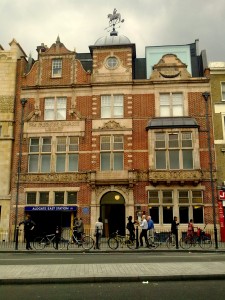
The old Whitechapel library played a crucial part in the literary history of this fluid, immigrant-fuelled eastern fringe of the City of London. The library, its beautiful red-brick façade crouching over the entrance to Aldgate East tube, was founded in 1892 by the prolific Victorian benefactor of the working classes, John Passmore Edwards. It was an important local institution for the Jewish community in the area, nicknamed the University of the Ghetto, and many writers who grew up in the area were regular visitors, using the library as an escape, and its books as an education.
Artists Mark Gertler and David Bomberg and the poet Isaac Rosenberg were regulars, later to be known as members of the Whitechapel Boys. The playwright and poet Bernard Kops hid from the realities of poverty and overcrowding in the reading rooms, later writing a poem as a tribute. “A loner in love with words, but so lost / and wandering the streets, not counting the cost. / I emerged out of childhood with nowhere to hide / when a door called my name / and pulled me inside. / And being so hungry I fell on the feast. / Whitechapel Library, Aldgate East.”
When Whitechapel library closed, the playwright Arnold Wesker, who used the library as a boy, was one of the critics of the move. “Whitechapel Library blazed the way and excited my love of reading books. It was a safe space with a reference room where old men read newspapers they couldn’t afford to buy. I owe the library a debt and lament its passing.”
 But the thing is, Wesker’s description of that library, and Bernard Kops’s vision of it in his poem, could both apply equally now to the Idea Store. At the time, news reports on the Idea Store were sniffy about the fact that it promoted itself as being “next to Sainsbury’s”, as if the whole concept equated borrowing a book to buying a pint of milk. But what’s wrong with being next to Sainsbury’s? Supermarkets are generally in convenient places – why shouldn’t books be too? Slap bang in the middle of the straggling and chaotic market that runs down Whitechapel Road, the Idea Store is in the heart of the community it serves. The doors are open, and the glass frontage means you see what you’re going in to. It’s not intimidating, it’s busy and buzzy. The ground floor is crowded, but as you go upwards into the building the floors become hushed and peaceful, with readers relaxing in chairs and at desks. Here are Wesker’s old men reading papers they can’t afford, side by side with students and other readers of all kinds. By the fourth floor, with its café and spectacular views over the City, I’d decided this is somewhere I’d happily come to read.
 Perhaps change is a good thing for libraries. I love the musty, hushed beauty of Victorian libraries, but I also recognize that they risk becoming irrelevant to many people in the 21st Century if they don’t change with the times. That’s not to say that books are irrelevant – far from it. Libraries have over 12.6 million active borrowers a year, and books are still at the heart of what they do. But it’s not all they do. They’re a crucial part of local communities, and that’s not just down to the dusty tomes.
George Orwell wrote that bookshops attract ‘not quite certifiable lunatics’ because they’re ‘one of the few places you can hang about for a long time without spending any money.’ Never mind the lunatics – we all need somewhere we can loiter without pressure to move along or make a purchase. People need somewhere they can go and ask for information, knowledge and help, and feel confident it will be given to them, for free. The library is that place.
 The most worrying thing for me about the current plans for the future of libraries is the idea that they might become virtual spaces, where we order our books online and get them through the post. One of the crucial things about a library is that it’s a place you can visit. You can go there, talk to a librarian, sit down, read and spend time. You can take the kids and let them get their hands on books, make their own choices, listen to stories and join in. A friend of mine who works in a library seems to spend most of her time being something like a cross between a Citizen’s Advice Bureau, a social worker and a psychologist to her customers. Bernard Kops wrote about the library as a refuge and an escape, which wouldn’t have really worked if he’d been ordering his books on the net.
So, whether it’s an old red-brick building or a glass-fronted replacement, whether it’s run by paid staff or volunteers, whether it has shelves full of books or rooms full of terminals, a library needs a building, a real one. We shut the doors at our peril.

About Emily Cleaver
Emily Cleaver is Litro's Online Editor. She is passionate about short stories and writes, reads and reviews them. Her own stories have been published in the London Lies anthology from Arachne Press, Paraxis, .Cent, The Mechanics’ Institute Review, One Eye Grey, and Smoke magazines, performed to audiences at Liars League, Stand Up Tragedy, WritLOUD, Tales of the Decongested and Spark London and broadcasted on Resonance FM and Pagan Radio. As a former manager of one of London’s oldest second-hand bookshops, she also blogs about old and obscure books. You can read her tiny true dramas about working in a secondhand bookshop at smallplays.com and see more of her writing at emilycleaver.net.


The Whitechapel library was the first of the twenty two free libraries funded by Passmore Edwards and there were many more libraries supplied to village institutes, boys clubs and nurses homes as well as more than 80,000 books. Next year is the centenary of the death of this great Victorian philanthropist and events will take place at many of the surviving Passmore Edwards buildings to celebrate his lasting legacy.
I couldn’t agree more with all of this. The notion that libraries can be closed because library services are being made redundant by the internet couldn’t be further from the truth and your point about libraries being a place to visit is spot on. I really fear for the future of local libraries, and the people who work in them, and the people that depend on them.
they cant replace libraries with the internet. Libraries provide a studious and productive environment for all of us. There are few who use the internet for its ‘helpful and progressive’ uses and i doubt anyone has ever thought about googling ‘health problems or world peace’ over opening their facebook page and staying online for hours.
Not many people like to read nowadays but when you go to a library and look around you , you find yourslef in a trance like state, no noise and surrounded by shelves and shelves of books.
No one will EVER bother to order books by email. there wont be much incentive, plus there’ll always be that missing feeling of there not being any place where you can physically search for the books you want. No libraries = one less productive activity.
Yes libraries are great places but to say “No one will EVER bother to order books by email” is frankly nonsense. Amazon sales of eBooks now exceeds their hardback sales and as prices of eBook readers falls (99.99 in Waterstones) more people will acquire the technology and download their books from the net, either purchased or from online libraries. The music industry initially dug its head in the sand as the ‘E’ revolution went on regardless – the publishing industry and libraries must embrace the opportunities of the 21st century and adapt or die.
well, obviously , no ones questioning the coexistence of libraries and Ebooks but imagine what life would be like if libraries are completely shutdown.
imagine if your a kid and you enter a world where there are no libraries . of course, i may be wrong but i think that in the start (early years)we all need a little push , a little incentive and without the ‘library atmosphere’ reading will gradually die out.
once again, i could always be wrong.