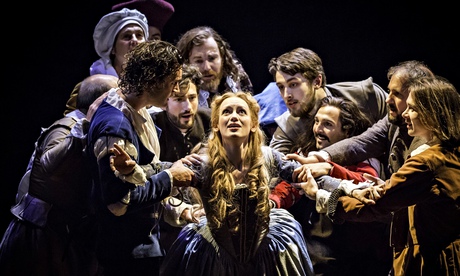
Setting Othello in early 20th century India is a radical choice, and one that brings with it a number of risks.
...
How does Joe Hill-Gibbins’ bold new production of Measure For Measure deal with Shakespeare’s “problem play”? Unproblematically, says Xenobe Purvis.
...
This year, the Rose Theatre is staging an ambitious experiment: four different versions of Twelfth Night in rep, each with a different gender permutation. It engages, amuses and disconcerts, writes ...
Hailey Bachrach refused to believe that King Lear With Sheep existed. But then she went. And it was real. King Lear… performed by sheep.
...
In her second review from this year’s Wilderness Festival, Becky Ayre watches a charming outdoor version of Twelfth Night.
...
Hailey Bachrach watches three different versions of Shakespeare’s Henry V – one in Galway (at the Mick Lally Theatre) and two in London (at the Unicorn Theatre and the Wheatsheaf ...
Just as the Globe and Propeller present all-male Shakespeare without explaining why, Smooth-Faced Gentlemen’s all-female Titus Andronicus offers no commentary for its casting: it simply is.
...
It’s often overlooked that Othello ends with not one, but two, marital murders. This bold new production, set in contemporary London, allows Emilia’s tragedy to stand alongside Desdemona’s.
...
As Shakespeare in Love opens at the Noel Coward Theatre, Xenobe Purvis looks at how generations have shaped the Bard in their image.
...
While Sam Mendes’ totalitarian King Lear holds gory court at the National Theatre, a fledgling new writing night by SALT Theatre offers an irreverent spin on Shakespeare’s grimmest tragedy. Lauren ...
Philip Davis, editor of The Reader Magazine, puts Shakespeare in an fMRI and watches the brain light up, its pathways shift.
...
“And it was this way of life that Thomas Decker was challenging when he called upon his compatriots to consider their language as a legitimate medium not only for conducting ...
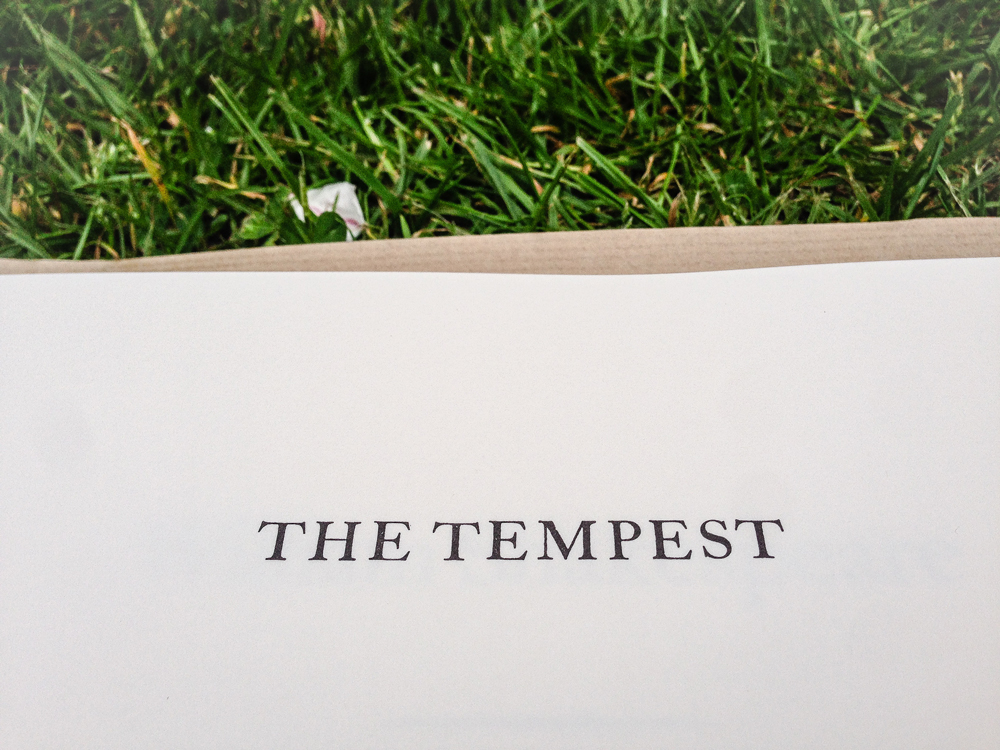
The Folio Society has been quietly turning out beautifully crafted letterpress editions of the works of Shakespeare. Litro recently had the chance to consider the craftwork, and goats, that went ...
In the last of our Shakespearean Sonnet competition winners, Philippa Barker contemplates her desktop.
...
In the fourth of our Shakespearean Sonnet competition winners, Linda Atterton takes a new angle on Romeo and Juliet.
...
In the third of our Shakespearean Sonnet competition winners, Brian Robert Flynn revisits John Keats’ sonnet 635: ‘When I have fears that I may cease to be’.
...
In the first of our Shakespearean Sonnet competition winners, Uschi Gatward reappropriates Sonnet 66 for the modern economy.
...
“Imagine the scene: an angry father hauls his young daughter in front of a city governor, demanding the death penalty for her disobedience in refusing to marry the man he ...
Ann Skea looks back on why only Ted Hughes could have written Shakespeare and the Goddess of Complete Being — an audacious and imaginative reappraisal of the works of Shakespeare.
...
Rory Clements, whose sixth book in the John Shakespeare series of Elizabethan thrillers has just been published, uncovers a deadly circle of intrigue and treason in his hero’s home town, ...